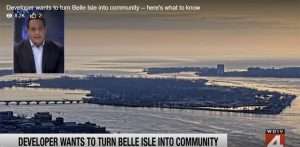
A bold new proposal is putting Belle Isle back in the spotlight—and it’s not a small idea.
Metro Detroit developer Rodney Lockwood has unveiled a plan to transform the island into a fully functioning city, privately funded and designed to house tens of thousands of residents.
It’s ambitious. It’s controversial. And right now, it’s still just a vision.
Watch the News Coverage
You can read the full report and watch the original coverage here: Full CBS Detroit report by Alysia Burgio on Belle Isle development.
What Is the Belle Isle-Freedom City Plan?
At its core, the proposal is about turning Belle Isle into a “city within a city.”
According to Lockwood, the project would:
- Be 100% privately funded (no taxpayer money involved)
- Become one of the largest privately funded developments in U.S. history
- Support a population of up to 50,000 residents
The concept includes:
- Residential housing
- Retail and restaurants
- Office and commercial space
- A walkable layout with transit features like a monorail system
The total estimated cost?
$50 billion.
Why Belle Isle?
The reasoning is actually pretty straightforward.
Belle Isle offers:
- A large, centralized landmass (nearly 1,000 acres)
- Proximity to downtown Detroit
- A single ownership structure (city-owned land)
- Strategic positioning between the U.S. and Canada
Lockwood argues the island is underutilized, and that portions of it could be developed while still preserving its role as a park.
The State’s Response: Not Interested
Here’s where things hit reality.
The Michigan Department of Natural Resources—which manages Belle Isle—has already responded:
- The proposal is not under consideration
- The state has focused on investing in the park itself
- Over $178 million has already been invested in improvements
- The island sees about 5.5 million visitors annually
That’s not a small obstacle, that’s a hard stop, at least for now.
What the Vision Represents
This isn’t just about one project. It’s about a broader shift in how cities think about growth.
The Belle Isle-Freedom City concept reflects:
- A push toward private investment over public funding
- A desire to build high-density, master-planned communities
- A model inspired by global hubs like Singapore and Dubai
It’s essentially asking:
What happens if you build a city from scratch—inside a city that’s already rebuilding?
The Tension: Public Space vs. Private Development
Belle Isle isn’t empty land—it’s a public park with deep cultural value.
That’s where the friction comes in.
On one side:
- Economic growth
- Job creation
- Increased investment
On the other:
- Public access
- Preservation of shared space
- Long-term control of the island
The challenge isn’t the idea—it’s how (or if) something like this could exist without fundamentally changing what Belle Isle represents.
Reality Check: This Is Still Early
Right now, this proposal is:
- In the planning phase
- Being discussed with local, state, and federal leaders
- Far from approval or execution
For it to move forward, it would require:
- Government approvals at multiple levels
- Regulatory changes
- Massive financial coordination
And as it stands, key decision-makers aren’t on board.
Final Thoughts
The Belle Isle-Freedom City plan is exactly the kind of idea that gets attention—for good reason.
It’s bold. It’s unconventional. And it forces a bigger conversation:
- How should cities grow?
- Who drives that growth?
- And what do we protect along the way?
Whether this project ever happens or not, one thing is clear:
Detroit isn’t standing still and ideas like this are proof that people are thinking much bigger about what comes next.