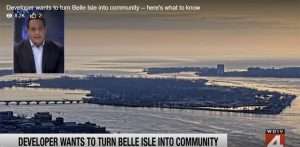
A recent discussion on YouTube breaks down the proposed development and the broader implications for Detroit.
Watch the Breakdown
The $50 Billion Plan to Transform Belle Isle: Opportunity or Overreach?
Detroit is no stranger to bold ideas, but this one is on another level.
A proposed $50 billion development aims to transform Belle Isle into a fully functioning “city within a city.” The vision? A privately funded, walkable urban hub that could house up to 50,000 residents while still maintaining parts of the island as a public park.
It’s ambitious. It’s controversial. And depending on who you ask, it’s either exactly what Detroit needs—or something that shouldn’t happen at all.
Let’s break it down.
What’s Actually Being Proposed?
At the center of the plan is developer Rodney Lockwood, who envisions transforming Belle Isle into a global destination—comparable to places like Singapore or Dubai.
Key elements of the proposal include:
- A privately funded $50 billion development
- A long-term lease from the city (not full ownership)
- A $1 billion upfront payment + $50 million annually
- Housing for up to 50,000 residents
- Mixed-use development: residential, retail, offices, entertainment
- A walkable, master-planned urban environment
- Tens of thousands of jobs (estimated ~46,000)
There’s also talk of structuring it as a special economic zone, with favorable tax and regulatory conditions to attract investment.
On paper, it’s the largest privately funded development of its kind in the U.S.
The Reality Check: This Isn’t Happening Anytime Soon
Before people get too worked up—this is still early-stage.
The project would require multiple layers of approval at the city, state, and likely federal level. And as of now, the Michigan Department of Natural Resources has made it clear they are not involved and not considering the proposal.
Translation: this is a concept, not a deal.
Why Belle Isle Matters (And Why This Is Sensitive)
Belle Isle isn’t just land—it’s part of Detroit’s identity.
- It’s owned by the city but managed by the state
- It became state-managed after Detroit’s financial crisis
- It’s a heavily used public park with deep cultural significance
- It draws millions of visitors annually
That’s where the tension comes in.
You’re not just talking about development—you’re talking about changing how people experience one of the city’s most iconic spaces.
The Core Debate: Progress vs. Preservation
This proposal hits a nerve because it sits right at the intersection of two competing mindsets.
1. The Case for Development
Supporters see this as a no-brainer:
- The island currently costs money to maintain
- This plan would generate revenue for the city
- It would bring jobs, infrastructure, and investment
- It could accelerate Detroit’s long-term growth trajectory
There’s also a bigger point being made:
Detroit is already on an upward trajectory, and large-scale investment is happening across the city. This would simply be an extension of that momentum.
2. The Concerns
On the other side, critics raise valid concerns:
- Access: Will it still feel like a public space?
- Affordability: Who can actually live there?
- Gentrification fears
- Loss of cultural identity
Even if the island technically remains accessible, perception matters. If people feel pushed out, the damage is already done.
The Bigger Conversation: Investment and Ownership
The most interesting part of the transcript isn’t the project itself—it’s the mindset behind it.
There’s a strong argument being made:
People often resist development—but also don’t invest in their own communities.
And that’s uncomfortable, but worth sitting with.
Because the reality is:
- Cities grow where capital flows
- Development doesn’t wait for consensus
- And if locals don’t invest early, outsiders will
Detroit, in particular, has been quietly building momentum for years—through infrastructure, sports, business, and real estate.
The question isn’t if growth is coming.
It’s who benefits from it.
So… Is This a Good Idea?
Here’s the honest answer:
It’s both.
- Yes, it could bring massive economic upside
- Yes, it could reshape Detroit in a powerful way
- And yes, it could also create real tension if not handled carefully
Right now, it’s just a vision. But it’s the kind of vision that forces a bigger conversation—about ownership, opportunity, and what the future of Detroit should actually look like.
Final Thought
Whether this specific project happens or not almost doesn’t matter.
What matters is what it represents:
Detroit is no longer being overlooked.
People are paying attention.
And big money is starting to move.
The real question is—who’s ready for it?